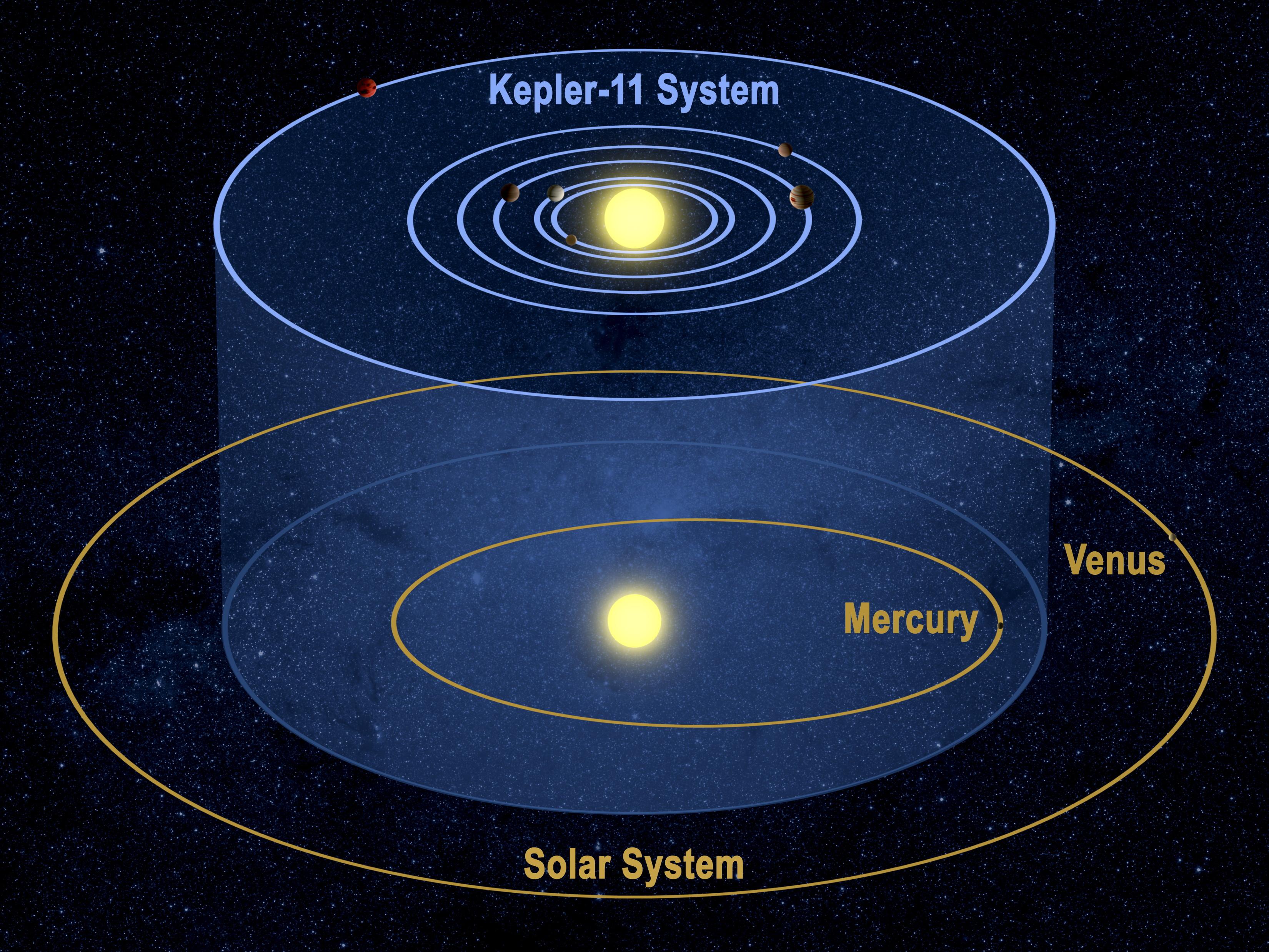
The Kepler mission to discover new planets, which there is a blog post about a few posts down, has come up with some incredile results. A confirmed 11 planetary systems that host 26 planets, previously unknown, have been found. This doubles the number of confirmed planets found by Kepler and gives us new insight to how other planetary systems work, esspecially ones compact as these.. More then half of the newly discovered planets are around the size of Earth, and every single one of them is closer to their star then Venus is to our sun. The planetary system with the most exoplanets is Kepler-33, which has five Earth sized planets. Kepler discovers these systems using light detection, noticing when the light from a star is changed. This occurs when an orbiting planet passes in front of it. Once they suspect Kepler has found a planet they focus all of their resources and time to verifying it was a planet instead of some other space mass.
Because these systems are so compact the gravity of the exoplanets can effect each other, causing something called Transit Timing Variations. This is when a planets orbit is either speed up or slowed down by anothers gravity, Kepler is helping us understand how this works in these new systems.
The discovery of these new systems are published in four different papers in the Astrophysical Journal and the Monthly Notices of the Royal Astronomical Society, and on Nasa.gov.
"Prior to the Kepler mission, we knew of perhaps 500 exoplanets across the whole sky. Now, in just two years staring at a patch of sky not much bigger than your fist, Kepler has discovered more than 60 planets and more than 2,300 planet candidates. This tells us that our galaxy is positively loaded with planets of all sizes and orbits." - Doug Hudgins, Kepler program scientist at NASA.