Tuesday, March 6, 2012

Atmospheric Oxygen Within the Solar System?

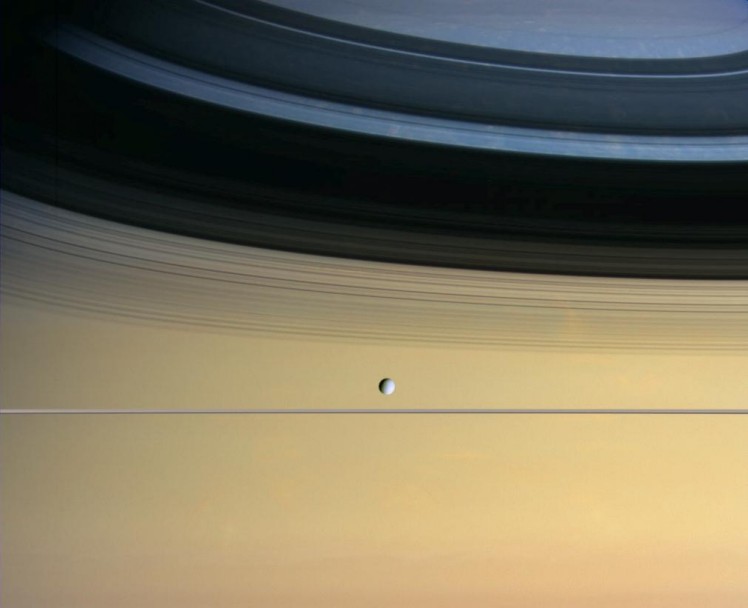
Saturn is a planet of many moons. Most of these moons are small and desolate, but one stands apart. Scientists have observed the icy moon Dione to have a small, weak atmosphere. The Cassini probe detected trace amounts of oxygen on the surface of the moon, the only other celestial body besides earth in the solar system where we have done so. Scientists think that this oxygen comes from solar photons bombarding the moon's icy surface, releasing oxygen. This is significant for many reasons; one is that it could indicate that oxygen is not as uncommon as we once thought. (there is also oxygen in Saturn's rings and its moon Rhea) Also, it shows us that moons are also candidates for habitability.


Make no mistake, Dione's atmosphere is weak. As interesting as the mental image is, we could not survive there unaided. But if water and oxygen can exist in places like this, it's entirely possible that they are more common than we originally thought. This carries a lot of significance for the fields of human space travel and habitable exoplanets. Perhaps we will eventually find a planet that could be colonized with little more than an adequate space ship!

http://www.jpl.nasa.gov/news/news.cfm?release=2012-056&cid=release_2012-056

Understanding the Beauty of Far Away Galaxies

Galaxies have always fascinated me, especially being able to see distant ones in pictures. It amazes me that all those stars, planets, and miscellaneous masses can be condensed into a mere image made up of pixels on my computer screen. Of course, for the majority of my lifetime I have known surprisingly little about them, and since the way I see the world allows me to see even more beauty in something when I understand it, I've decided to ponder the implications of those pixels on my screen.

This is a spiral galaxy, the most common variety of galaxy there is. ESO 510-13 is it's name, and I learned of it from this article.
At first glance, it looks like a sort of thin, astronomical cuttlefish, or a trail of stardust left behind after the passage of some unknown object. I wouldn't have guessed it was a spiral galaxy before taking this class. In my mind spiral galaxies have always looked like the one below.
Well, it turns out they're the same thing from different perspectives. To quote an extraordinarily helpful definition, "If you can clearly see the spiral shape, the galaxy is called a "face-on spiral." If you instead see the galaxy from the side, it is called an "edge-on spiral."" This means that ESO 510-13 is an edge-on spiral, and if we were seeing it from a different angle it would look roughly similar to the lower picture. 

Why am I giving you all this information that you probably already know? I'm building up to what makes ESO 510-13 so special. See, edge-on spirals tend to look more like this one.
If you haven't noticed the difference, ESO 510-13 is slightly warped, like a piece of cloth hovering in space while the lower one looks more like a frisbee. According to the first link, "These disks are thought to flatten out the way they do by the nature of the collision of gas clouds early in a galaxy’s lifespan." If that's the case, why are some galaxies warped? We aren't sure of course, but it seems that the best idea of why ESO 510-13 has turned out the way it is is either galaxies hitting each other or their gravitational pulls battling it out.

I guess I'm just asking you all to process information instead of just seeing it. Do what astronomers do; do not only seek out these sights, but endeavor to learn the stories of how they came to be and what they really are.
Monday, March 5, 2012

Geologically Active Moon


Some think that the moon is dead, but new studies form NASA's Lunar Reconnaissance Orbiter proves that the moon is both shrinking, and expanding at the same time. This doesn't make much sense, but it is shrinking in some areas, and expanding in others. In the early stages of a planets evolution, most of the planets melted and reformed. However with the moon, only the outer layer melted and reformed, causing the center to still be very hot. "We think the moon is in a general state of global contraction because of cooling of a still hot interior," said Thomas Watters. Due to the changes in the moons surface, narrow trenches are formed called Graben. There are a handfull that have been found on the moon so far. It is estimated that the distance between the center and the surface shrunk by 300 feet.
This is really interesting to me because i never knew that planets and moons melted and reformed. Also i never thought of the moon being geologically active before. Does that mean that there can be high mountains on the moon? And if there is water on the moon, could there ever be an ocean?


Safe & Sound... For Now


For a while now we've known of an astroid near earth in the Sun's orbit, its a little guy at just about 150 ft in diameter. But if it hit us it wouldn't be good. There were some rumors circulating about this asteroid hitting earth. This s NOT true. On February 16, of 2012 it passed us with a good amount of space in between, about 1.5 million miles. This astroid comes by us about every six months. Although that was not a very close miss, next year was a skeptical year regarding weather or not we would get hit. In February it was proven that it will miss us next year, contrary to some of the rumors going around. It will get pretty close though next year, at about 17,000 miles. This is a clean miss on human terms, but in atronomy it will shave the hair on our chins. So at least for another year were safe!


I thought this was interesting because we know already what will happen. Its really cool that we can use math and observation to predict our future. I thought that it was crazy to think that we are actually getting close to getting hit, but fortunatly we have enough information to tell when/if that will happen.

atmosphiric oxygen found on dione, saturns moon


Cassini, a NASA Space craft sniffed oxygen around saturns icy moon dione for the first time, creating the possibility there could be an atmosphere, although the oxygen ions are few and far between.
i thought this was cool because Dione would be another celestial body joining the ranks of planets with atmospheres, like eath, venus reah and possible mars.
http://www.jpl.nasa.gov/news/news.cfm?release=2012-056&cid=release_2012-056

Sunday, March 4, 2012

A cluster of galaxies Dark matter core cannot be explained by current theories

Astronomers used the Hubble Telescope to discover what they believe is a clump of dark matter left over from wreckage between large clusters of galaxies. This finding could change the current theories about dark matter and how galaxies should be attached to this invisible at all times including when it is facing the shock of a collision. Abell 520 is a cluster of galaxies 2.4 billion light years away. The dark matter has formed itself into a core, and contains fewer galaxies than would be expected than if they were anchored together. When originally discovered in 2007 astronomers had claimed it was unreal, due to poor data, but further analysis from the hubble telescope confirms that the dark matter and galaxies are indeed, not attached. "Dark matter is not behaving as predicted, and it's not obviously clear what is going on. It is difficult to explain this Hubble observation with the current theories of galaxy formation and dark matter." The original theory was backed up by visible light and X-ray observations of another collision between to galaxy clusters called the Bullet cluster, which became an example of how galatic grouping should be. But after analyzing Abell 520 we believe the behavior of dark matter might not be as simple as we had thought. Its core contained a lot of dark matter and hot gas, but no luminous galaxies. "We know of maybe six examples of high-speed galaxy cluster collisions where the dark matter has been mapped. But the Bullet Cluster and Abell 520 are the two that show the clearest evidence of recent mergers, and they are inconsistent with each other. No single theory explains the different behavior of dark matter in those two collisions.” More data needs to be collected. Many theories have been proposed, but they are unsettling for astonomers.
This is issue is a very sensative thing. On one hand if we are wrong about how dark matter works to a high extent then it could start to affect other theories we have come up with and show us that we know very little about our universe. On the other hand this anomaly cannot easily be explained by informationwe currently have on the subject, which is very little because of dark matters properties it is very hard study. I personally think more data should be gathered before we really start to form opinions or hypotheses on the subject

http://images.sciencedaily.com/2012/03/120302101413-large.jpg


source:http://www.sciencedaily.com/releases/2012/03/120302101413.htm

Tornado on the Surface of the Sun


Source: A Tornado on the Sun via NPR
The Sun is a very active star with a history of spewing radiation and atomic particles into space. In early February, NASA recorded a video of a tornado of plasma the size of Earth spinning around the Sun's magnetic fields. The tornado generated gusts up to 300,000 mph; to put that into perspective, our strongest tornadoes can only generate up to 300 mph gusts. Click to see video.


The Sun's weather will be a fascinating thing to observe and see change in. The Sun's weather has real world effects for the inhabitants on Earth, and I think it would be really cool if the general public paid more attention to the everyday phenomenons that occur on the surface of the Sun. More resources: Solar Dynamic Observatory's Pick of the Week.