Wednesday, January 18, 2012

"The Fat One" - The Largest Gravity Bound Structure in The Universe

'El Gordo,' Galaxy With Mass 2 Quadrillion Times the Sun's, Discovered via NPR

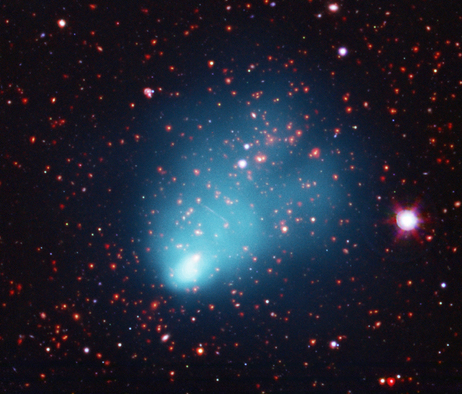
Astronomers in Chile at Rutgers University have discovered the "most massive" galaxy cluster ever seen in the universe. "El Gordo" is 2,000,000,000,000,000 quadrillion (15 zeros!) suns and 7 billion light years away. A galaxy cluster is made up of hundreds of thousands of galaxies bound together by gravity. They are formed when clouds of hot gas (30-100 million degrees Celsius) envelop galaxies and fill in the space between them. This is does not provide enough mass to hold together the galaxies, so scientists believe dark matter is required to provide the extra gravity. "El Gordo" is important because it allows astronomers to study how the universe is growing and it is a really big laboratory for astrophysicists. "El Gordo" is forming a picture on how the universe formed by providing a model to measure the amount of dark matter and dark energy that makes up the universe. The astronomers also had the chance to watch two cluster merge together. The two clusters collided and "crushed" each other when hot gas from one cluster was absorbed into the other structure. So essentially, one cluster passed through another cluster.

The whole idea that hundreds of thousands of galaxies 'cluster' together out there in deep space is completely mind blowing to me. It's really cool that this cluster of galaxies can help us in finding out how the universe formed and how it is growing.

Wednesday, January 11, 2012

The Habitable Zone and the Possibility that We Are Not Alone


http://www.jpl.nasa.gov/news/news.cfm?release=2011-373&cid=release_2011-373

What makes Earth so special? Our planet harbors everything necessary for life, which is an extraordinary coincidence. We have liquid water, oxygen, and enough sunlight that we are neither too hot nor too cold. These criteria for any life at all, not to mention intelligent life, are so specific that we have never confirmed them anywhere else in the known universe. We are lucky to exist in something called the habitable zone, an area of orbit around a sun that can produce life in planets. We could not comfortably live in any planet out of the habitable zone without respirators, pressurized suits, specialized buildings and vehicles, etc.

As you can see, a habitable zone occupied by a solid planet is exceedingly rare. Most solar system's zones are far beyond their farthest planet, or so close to the star that the planets are frigid. As a species, our space programs allow us to shout into the void, calling out for reassurance that we aren't the only intelligent life in the universe. Even physicist Steven Hawking says it would be foolish to think we are alone in such a gargantuan space.
NASA's Kepler mission, an attempt to find the habitable zone in other systems, has provided intriguing results. Kepler has found several hundred candidates that MAY be in the habitable zone, and one looks especially promising. The planet, christened Kepler-22b, is near earth size, and orbits in the zone where liquid water may well exist. 22b is slightly larger than earth, but its 290 day year is not so much different from ours. It is 600 light-years away, making travel there currently impossible, but we will continue to study it from our place in the universe. Who knows? Maybe we're being studied back.

Tuesday, January 10, 2012

Stars Beat Planets

By Gracie Currier-Tait


A study published in the journal Nature, and featured at the American Astronomical Society's conference shows that most of our stars in the Milky Way, have planets. That being said, there are many stars in our galaxy, and scientists suggest there are a lot more planets out there.

About 100 billion to be exact.

Found through the article Astronomers See More Planets Than Stars in Galaxy from Pj Star, astronomers are beginning to fathom just how many planets could be out there.

One study in Nature estimates that for every star in the Milky Way, it averages at least 1.6 planets per star. Astronomers use different techniques and tools to estimate just how many planets are out there. We have confirmed over 700 exoplanets (planets outside our solar system), while thousands remain un-confirmed.

Astronomers are discovering a plethora of other interesting discoveries, such as the Star Wars-eque planet with two suns, or the miniature star system with its own tiny sun and dwarf planets. "We're finding an exciting potpourri of things we didn't even think could exist," said Harvard University astronomer Lisa Kaltenegger.


I personally find this to be fascinating. Although we have very little knowledge about our galaxy, I am all for the belief in the infinite and unknown. The idea of there maybe being 100 billion planets in our small patch of space is unbelievable... I'll be interested in finding out what other planets are out there.


Friday, March 18, 2011

Eye Of Sauron!


Well, okay, not really. This article is about the active black hole in the galaxy NGC 4151, known as the Eye of Sauron, and it’s about 43 million light-years away from Earth. Recent studies showed that the black hole emitted a very healthy amount of X-rays recently as well. The central region of the galaxy, the “pupil” of the eye, is where the supermassive black hole is, and in this picture, you can see that the blue is x-ray emission. Two different scenarios to explain this emission’s been explored: one is that the black hole grew much more quickly around 25,000 years ago, and radiation was so bright it stripped electrons away from the atoms in the gas in its path. X-rays were emitted when electrons recombined with those ionized atoms. Another possibility is also about the inflow of material, but this scenario says it happened fairly recently. Energy released by the inflow made a nice healthy outflow of gas at x-ray emitting temperatures.

While knowing what this black hole is doing is interesting, my primary interest in this event was in the name, the Eye of Sauron. I never knew galaxies could look like NGC 4151, and the x-ray emission is interesting.

Link: http://www.astronomy.com/en/News-Observing/News/2011/03/NGC%204151%20active%20black%20hole%20in%20the%20Eye%20of%20Sauron.aspx

Quasar's Belch

In a press release from the Gemini Observatory on 23rd of February in 2011, it was revealed that they discovered an extreme, large-scale galactic outflow in the super-massive black hole at the center of the galaxy Mrk 231, which is, I believe, merging with another large galaxy—exciting this black hole. As far as I understand it, outflow is a process that takes place while the black hole is acquiring mass as a quasar. The outflows “carry away energy and material, suppressing further growth.” Apparently small-scale outflows had been seen before, but nothing on this scale: the power of this outflow is pretty much blowing this massive galaxy apart with its negative feedback look (a process I don’t understand, regrettably), which is self-destructive because the black hole will soon be unable to get the gas and dust it needs to sustain itself. This process also limits the material that this galaxy can get to make new generations of stars. You’d think this is a moot issue because it’s getting blown apart, but it’s highly relevant, really, because the stars are just fine; it’s just the dust and gas in this galaxy that are getting pushed away. Without this material, they really cannot reproduce.

Scientists are excited about this finding because it’s a fabulous example of outflows caused by negative feedback from black holes like this. It’s relatively close to Earth, and beautifully shows the example of a merging large galaxy that’s “shedding its cocoon and revealing a very energetic central quasar.”

I think this is incredible. The concept of black holes within itself is terrifying, though wonderful at the same time; knowing more about supermassive black holes and the impact they have on their galaxies gives us deeper understanding about our own galaxy.

Link: http://www.gemini.edu/node/11614

Thursday, March 17, 2011

Elongated crater in Mars


The article I read was titled Mars Crater Gouged by Multiple Impacts and was about "High-resolution images released today by the European Space Agency reveal new details about an unusually elongated crater on Mars that may have been blasted by several objects striking the planet's surface at a shallow angle." The crater is said to be about 78 kilometers long, approximately 25 kilometers across at its widest point, and about 2 kilometers deep. The three deep spots (shown in blue) suggest that the crater was struck by multiple impacts .

I think this is very interesting and proves that comets colliding onto planets can happen. Also if there were life carrying asteroids as Bayani's post discussed this could help prove that life was started that way. But regardless of that I think this is very interesting.

Hubble Zooms in on a Space Oddity

The Hubble has recently uncovered a very strange green glowing gas cloud. It was first observed by a Dutch school teacher who was using the Internet site http://www.galaxyzoo.org/ to catalog galaxies. It became an issue of great interest because no one knew what it was or why it was there. It at first appeared to only be a floating gas could near a galaxy however NASA has recently discovered that this galaxy could have been essential to the creation of this mystery. It is believed that this galaxy once harbored a Quasar in its center which blasted this blob of gas with energy and light so that it maintains the light even though the Quasar is no longer there.
I think that this discovery is really cool because many things but probably the most exciting thing about this is the way it was discovered. It was first found by a dutch school teacher who was just trying to catalog galaxies when she came across a faint green glow when she was observing one galaxy. She asked a couple astronomers what it may be but no one knew so they applied for some Hubble time in order to take  closer look. It began to get more and more attention and more telescopes began to turn to observe this phenomenon. This shows that you don’t have to be an astronomer in order to make discoverys and that anyone can do it.